Showing posts with label Yemen. Show all posts

Monday, June 27, 2011

Orphans


I look at this picture sometimes when I am feeling sorry for myself. This is a group of little girls living in a Muslim orphanage about an hour east of Dar es Salaam, Tanzania. I spent a very nice afternoon there a few years ago while working with a American philanthropist who was helping poor schools throughout East Africa and Asia. I was doing a site visit, checking on the school that had received educational resources through the foundation and was afforded a tour. I stopped here in their dorm room for about twenty minutes. The young ladies introduced themselves, and then sang me three songs: one in English, one in Swahili, and one in Arabic at my request (translated - We love you Allah). It was hard to leave, but one of them walked me to the gate, holding my hand making sure I found my way back to the Landrover. I think of her and her friends often, not only in my pitiful moods.
All in all, I lived and worked with and in orphanages for more than five years of my life, and I have visited scores more. A funny thing happens when you visit an orphanage, you leave feeling better than you entered. They who have so little can do that for you. However, there is always a hangover.
I don't know if you have ever been in a refugee camp or an orphanage in the third world, but they are far from attractive places. They are stark and bare, often smell of urine and worse things, and are as far away from the comfort you would afford yourself as you could possibly imagine. And as unfriendly as the concrete walls,thread-worn linen, and tattered mattresses can be, the lack of a mother's arms, a father's stern, soft strength makes the place worse than dead, worse than a nightmare populated with cruelties - a place where life ceases or never even begins. Yet these children survive, and become testaments to all that is good and holy in the human spirit, at a terrible, terrible cost. I have been "blessed" with this lesson over and over again, and I loathe the fact I forget it, no matter how temporarily.
I stumbled on my first job in an orphanage in Jamaica as a Peace Corps Volunteer. My primary assignment didn't work out so I was sent to Montego Bay to find something. After talking to several service agencies, I learned about a boy's home on the edge of town, inhabiting an old tourist hotel overlooking the airport. I have chronicled my fortuitous job interview elsewhere, and I did end up working there for a year as the full-time teacher, and another year as a PE instructor and occasional field trip supervisor. I don't remember what I taught them or where I took them, but I remember their faces twenty five years later, and am saddled with the loss that I didn't hug or hold them as I should have. No one did, the matrons were decent women, but were overworked and underpaid, and struggled with their own survival issues. The occasional slap or spanking, or knuckle sandwich provided by an older peer were what passed for physical intimacy at the Fairmont Boy's Home. The boys were friendly and good-natured, but I knew there was a toll for this deficit of love. And in two years, I saw some beautiful smiles fade gradually, and I could do nothing to resurrect that bit of their humanity, nothing.
After a year's sabbatical back in the states, I returned to the Peace Corps and spent two years living and working in an Eritrean refugee camp on the shores of the Red Sea in Yemen. In training, I learned of the camp and did everything I could, lobbying to be assigned in the nearby village of Khawkha. It was in the Tihama, the narrow coastal region of North Yemen: hot, harsh, and humid. The Ministry of Education balked at first, not wanting to send any westerners into that climate, least of all to a small village with poor electric and other basic services. Though, with the help of a few wonderful Peace Corp Yemeni staff, we eventually secured permission and I was off to one of the hottest, remote places in the Arabian gulf.
The refugees were Muslims from the southern tip of Eritrea, a small minority of Afar speaking tribes. I helped another volunteer build a school in the camp, and was allowed to move into one of the small shacks previously occupied by the camp doctor (another story - see "Where There is no Doctor"). I stayed there the first year, and lived in an eight foot by eight foot tent the second year. I had the benefit of a year's reflection on my first experience in Jamaica, and was resolved to do things differently on this trip. I did do things differently, had a wonderful and heartbreaking time, contracted malaria three times, and left the camp with jaundiced eyes and a mild case of hepatitis.
I knew from the beginning that hygiene was going to be a problem. There was no running water in the camp, no toilet paper, not even a bathroom facility - there were trees a half-mile away in the day time, and a sandy, rocky plain next door at night. The kids played all day in dirt, and as there was no washroom let alone the sign admonishing us to wash our hands afterwards, things were sometimes messy. When the children came into my shack each night to hear music or play with my long (then brown) hair, I knew what was on their hands, knew where they had been. I played with them, taught them, laughed with them, cried sometimes, and gave more of myself to these children than anyone previously in my life. We sang songs at night, drawing pictures in the sand, and they all learned how to spell M-i-s-s-i-s-s-i-p-p-i in the dirt (I had a fairly stunted musical repertoire). They laughed until they cried when I showed them how to jump rope in my Tihama skirt, and they astounded me with their patience as they shared the few pieces of chalk I could spirit away from the village school. I made the girls earrings from seashells and a generous donation of components from a sweet young woman at the Claire's Boutique in South Bend, Indiana who thought I was cute (another story).
I know I was a queer spectacle for the adults who were pretty much split down the middle in their regard for me. Half thought I was crazy but kind, the other half despised me for breaching the established distance of adulthood. I didn't care, I was determined to make sure that these children had access to me, and that I learned to hug and love in the process. It was a good lesson for me, and I wish I could have retained it better, longer. There are times I wonder if I have made my own daughters half-orphans at least, doing a much worse job loving them than those children a lifetime ago, but I am working on it now. As for the kids in the camp, I try not to think of their faces now at night, for the warm smile produced is inevitably defeated by the cold cruel prospect of their eventual fate.
I travelled thousands of miles to find my concept of dignity in the desert dirt. These people, orphans, children and parents, showed me what was human - having been stripped of most everything the rest of us regard and lust after. Their simple sense of truth, endless compassion, and ability to face each day with strength and humor taught me what is valuable. I sorrows me that this wealth is assailed daily by neglect, disease, and apathy in thousands of such places every day, even today. How many children still face the day without a hug, without a smile, without a pair of pardoning arms to forgive or fix anything? Too many for me to feel very good for too long.
I still work with refugees and orphans, largely through teacher training initiatives. I don't often get into camps, and I never get to jump rope or spell funny sounding state names in the dirt anymore. But there is a legacy - I work a lot on the concept of student engagement, helping teachers help students find their voices. I talk a great deal about praise and acknowledgment, much more than classroom management and discipline. I know the difference these teachers can have with a kind word, a gentle pat on a shoulder. I try to do the same for them, these wonderful professionals who labor day in and day out in these places I find so dehumanizing, giving their students and children love and hope in the guise of a simple education. I envy them, and wish my five years had been fifty.

Saturday, October 16, 2010

Kusherie


I didn't come to kusherie the usual way. I am not sure there is a usual way, other than being Egyptian. Nonetheless, after a year of build up, and a false start, I finally had my first taste of kusherie, appropriately served in a plastic bucket. It quickly became my favorite thing about Egypt!
I should say that before I actually had my first experience with true kusherie, I was somewhat hesitant about many things Egyptian. I studied Ancient Mediterranean Civilizations for a year in a graduate program, and at that time, I was dying to see Egypt, particularly after reading Herodotus' second chapter in The Histories. A few years later, when I got my invitation to go to Yemen as a Peace Corps Volunteer, I was ecstatic that I would be in the same region. That is, until I met my first group of Egyptians.
I knew, of course, that I shouldn't have stereotyped them, but it was hard. They were a group of Egyptian teachers contracted to teach in the Yemeni school system. When I arrived in my village (very remote) after three months of training in the capital city of Sanaa, no one knew I was coming. The local school was glad to have an additional teacher, they just didn't know what to do with me. After an hour of discussion, they decided to put me in a very crowded house with their Egyptian teachers. I had a bed in a room with five other teachers. This didn't bother me right away, but it soon became a problem. Literally ten minutes after I had unpacked, I looked over to the foot of my bed to see one of the teachers squatting by my stereo, plug in hand. Before I could yell "no" he plugged it into an extension cord. The inevitable combustion of spark and smoke startled him and he dropped it on the floor (different electrical current). At that moment, I learned the colloquial Arabic term for "oops." I don't remember it. He kept his distance for a few weeks.
My Peace Corps driver who brought me to the village made a huge mistake and told the other teachers that I had additional money if I wanted Arabic lessons. They bombarded me. I was sympathetic to this, as I knew how little they earned, and they were supporting families. It was their exploitation of their Yemeni students that really burned me up. Soon after the term began, they informed me of their "enhancement practices" and more importantly, that I had to follow suit or the whole enterprise would crumble. This included charging students triple for their tests, providing correct answers for tests, and any other creative way to make a Riyal. I told them I would think about it, and left it alone.
They began to lobby me a few weeks later. The first attempts were over invitations to tea, where we chatted for an hour or so with elephant in the room slowly growing. They never dealt with me directly on the issue, but they tried all sorts of persuasion. I was offered gifts, gratuity, and guilt. I never caved in, and our relationship deteriorated, especially when it was my turn to go to the city to photocopy tests (I then was in charge of collecting the test fees). We finally came to a truce: I would no longer take their tests to photocopy, and I made my own tests and collected my own fees. They didn't lose their supplemental income, and I kept a bit of my integrity.
I did not get to know any of them very well. There was one teacher, Ahmed, who didn't participate in the gouging of his students. He was a gentle soul, and I wanted to get to know him. Two things ultimately prevented this though: 1) he caught grief for associating with me, and 2) I couldn't bear to visit his room. Ahmed would insist that I have a drink on every visit (no, not alcohol), and each one almost killed me. He would take a four inch glass, put two inches of Tang in it and two tablespoons of sugar. I cannot describe the experience!
So by the time I left Yemen, I had a very narrow view of Egyptian culture, dampening my desire to visit the country. It was nearly twenty years before I did make it to Cairo, and I loved it. By then, I had met many other Egyptian folk who weren't scratching to eak out an existence. As I began my overland trek from the east side of the Sinai towards Cairo, I met many very nice people and I had a good time. My primary mission was not necessarily to redeem my perception of Egyptians, it was to find and eat some kusherie.
I had an acquaintance who raved about this dish, the original Egyptian fast food. My friend couldn't really describe its contents, only that I had to try it or my trip was a failure. I looked forward to the challenge of finding authentic kusherie.
My first attempt was in a little village on the Sinai coast of the Red Sea. The village, Dhahab (Arabic for gold), is a popular diving spot. After a gorgeous seafood dinner, I returned to the waterfront the next morning searching for my first dish of kusherie. I was told enthusiastically that they could accommodate me and I waited for an hour. Finally, they brought me a plate of something and smiled broadly. I tried it and was unimpressed. An expert on the matter told me that it wasn't the real thing, so I continued my search.
I arrived in Cairo on Christmas Eve, struggling to find a hotel. I opted for an upscale place, and was determined to pursue my quest the next day, then visit the pyramids - in that order, I had my priorities. When I asked at the front desk in the morning, the desk clerk was a bit perplexed. He looked at me and said quizzically, "you want kusherie?" It was if I didn't know what I was asking for. Finally, a clerk next to him came over and told me there was a place just around the corner. I was excited.
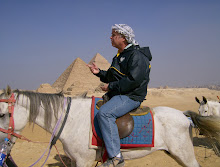
I left the hotel and navigated through traffic (Cairo traffic is unreal, you drive with one hand on the steering wheel, one hand on the horn, and no foot on the break). I walked into a very small restaurant with a few tables. On a shelf on the wall were hundreds of little plastic containers. There was a line of food stations behind a small counter, and I stood there mesmerized as the chef took ladles of all kinds of ingredients and slowly constructed my dish. I paid (about 25 cents) and took it to a table. I dug in and it was incredible - different flavors, different temperatures, different textures. It was the best breakfast I ever had. It gave me the fortitude to travel out to the pyramids and haggle with the guides providing horse back rides. It was a wonderful day.
Postscript - I managed to find an even better kusherie place in Alexandria, and I am very pleased to report that there is now a Mr. Kusherie in Amman, Jordan. The world is spinning in greased grooves!

Here is a recipe for this intoxicating mixture!
http://recipes.sparkpeople.com/recipe-detail.asp?recipe=226794

A few words about the pictures above: The kusherie is on the bottom! A satisfied customer sitting in kusherie joint a few hundered meters from the Library in Alexandria is on the top.

Tuesday, September 28, 2010

Pranks


I don't sit around planning pranks. Occasionally, they just sort of come to me. More often than not they fail, but some work out gloriously. Here are four pranks I have pulled over the past thirty years that have been fun and/or ironic.


"Friend" "Four"
While in Yemen, the Peace Corps headquarters in the capital arranged a one-year check-in conference for my group. We came from all over the country to the western sea port of Hodeidah for three days of sessions and bonding. We stayed at the Al Borg hotel, a very nice spot with good food (I was particularly fond of the lentil soup). It was a high rise hotel near downtown and not far from the beaches, a great place to get together. We roomed together in two's and three's. We all arrived a day early, and we were soon planning a pick up football game on the mud flats outside of town. As we were moving from room to room to gather recruits, I stopped by Steve and Eric's room to see if they wanted to play. Eric was 6'7" tall and a former semi-pro basketball player, quite an athlete. Steve was a world travelling laid-back zen master poet, sort of. I am still not sure what Steve is. Anyway, Eric agreed and Steve declined. Steve went into the bathroom and Eric and I devised a quick little gag (I should mention that Eric was a gentle giant, a very large hippie). I was quite surprised Eric went along with it actually. We moved an end table up against the door of the bathroom. The idea was that after we left, Steve would have to struggle to get out of the bathroom. We didn't bargain on two things however; 1)the end table was too heavy for Steve to move, and 2) Steve's really poor command of Arabic. He ended up locked in the bathroom for 4 hours.
After a few minutes struggling with the door and yelling, Steve realized we had left and no one inside the hotel would hear him. He managed to pry open the very small bathroom window and get his head out. The window faced the back alley, and there wasn't much foot traffic. The only people who passed by were local Yemeni with no English. When Steve first noticed a passerby, it hit him that he didn't know how convey his situation in Arabic. He realized he hadn't learned the word for "help" or the words for "fourth floor." He thought for as second and bellowed "Sadiq, arba." This is Arabic for "Friend, Four." Unfortunately, Steve had to repeat this appeal to about 20 quizzical sojourners before one thought to go inside and complain about the odd American yelling unintelligible things from a small window. We felt very bad that he spent his day in there, but he was a good sport. By the time we returned six hours later, Steve had been freed, and he had learned the Arabic world for help.
"Your Mini-Bar Bill Sir"
It was at another conference/reunion in Yemen, that I got to pull my next prank. Once again, it was a crime of opportunity. We were staying in a much fancier hotel, the Taj in Sanaa. Again we were assigned roommates, and there was a great deal of shuffling as various volunteers bargained to switch rooms for more "romantic clusterings." A group of us were about to head out and play basketball. We had quite a collection of athletes in that Peace Corps group: 1 college basketball player, 2 college football players, 1 college high jumper, and 1 college soccer player. We were always outside playing something from our early days in training to the sporadic reunions years after we left Yemen. The best athlete by far was Greg, a former starting linebacker for UCLA. Greg was a tough California surf dude. He was also smart - an English major. Greg was fun loving, and usually up for anything. With all that going for him, he had one fatal, exploitable flaw - he was a bit cheap to say it mildly. We were all gathered in the lobby by the bar waiting for Greg to come down to join us. We sat on comfortable benches facing the front desk. I sat there, bored and a bit irritated from waiting when a terrible idea came to me. I walked over to the house phone and called Greg's room. Now I will not try to emulate here the really horrible Indian accent I employed (the hotel was owned and operated by Indians), but it must have been convincing. I identified myself as Rajid at the front desk, and I proceeded to tell "Mr. Bolin" about all the missing items from his mini-fridge and that he needed to rectify the situation before I left my shift. Greg argued with me earnestly, then accepted my invitation to come downstairs to settle the matter discretely. I walked back to the group, got their attention and said, "wait three minutes and watch what happens at the front desk." True to form, Greg appeared shortly thereafter and made a beeline for the front desk from the elevator. We had front row seats. We couldn't hear him, but we could see him gesticulating from behind, and we could also see the sincere yet confused faces of the front desk staff. Greg flailed his arms about for a minute or so, then caught on something wasn't right. All of a sudden, he spun around to see ten of his peers rolling around on the lobby floor. I did go over and offer my apologies to the staff later who did not seem to understand the humor in the event. Sadly, Greg passed away four years later. Right after finishing his MBA, getting a job on Wall Street, and becoming engaged, Greg was struck by a car that had lost control on a California curve while he was bicycling.
"Tasmanian Devils"
When I was in college, I lived in a doubly abysmal place - it was a fraternity with a group of football players: every mother's nightmare! It was pretty raucous there, and we all learned how to patch drywall. Alcohol, testosterone, and suspect intellects do not a good party make. Periodically, someone would introduce a foreign element into the environment that would have devastating effects. For some reason, one resident thought it would be fun to bring a cattle prod to the house. Five fights and $1000 in damages later, it was discarded. Then there was the dartgun. I won't go into that. Not everyone in the house was big and rowdy, but most learned how to defend themselves. One such reluctant warrior was Mark who stood 5'8 and weighed 130 lbs soaking wet. I don't know how we started a feud, but it quickly escalated to a war. I personally think Mark overcompensated due to his slight stature, and that he was the more unreasonable combatant....
I remember noticing that things were getting more serious about halfway through the feud. I had broken into his room and put Icy Hot in his underwear. I got the salve from football practice, but it took me three days to find the rubber gloves - I wasn't going into his drawers drawers unprotected. A few days later I opened my door to find I no longer owned sheets, pillows, or bedcovers. I thought I had smelled something burning in the back when I came in that day.
It was an unwritten law that you could not discuss or confront your adversary about these issues, you simply continued until one capitulated. I had underestimated Mark. I waited until Mark went home for a long weekend, then rigged a small bucket of all ready turning milk to dump on his head when he walked through his door. I wasn't home when he tripped the trap, but I smelled that awful stench for a week. I was on my toes constantly after that day, expecting the inevitable retaliation. It didn't come for awhile, so I thought I had prevailed. At least until I heard the upstairs smoke detector going off. I was downstairs in a meeting when the alarm sounded. We all rushed upstairs to see a gentle plum of smoke coming out from under my door. I rushed through the doorway to find a large barbecue grill sitting in the middle of the room. On it sat my prize possession, a stuffed Tasmanian Devil doll engulfed in flames. I tried to rescue it and burned my hands. When the chaos subsided,I realized that I admired and feared Mark now, but the feud had gone public and I had to make a statement. I had lost a friendly devil and gained a malevolent one. I waited three weeks.
Mark had some weaknesses - he had a prissy young girlfriend and two very conservative evangelical parents. I waited for the confluence to occur then I struck. Actually, I sort of created the illusion of the confluence, but that is a technicality. Mark's girlfriend would often spend the night, and they went to elaborate lengths to conceal the fact, although we all knew. Once every few months, Mark's parents would come to the house and he would make us clean up and leave when they arrived. As I mentioned, he had two nice weaknesses.
I waited until his girlfriend spent the night on a Saturday. I woke up at about 5:30am and I unfolded my simple, brutal retort. I made a very lovely pattern of thumbtacks outside his door, took out the hallway light bulb, and banged on his door. I did my best to muffle my voice and declared "Mark, your parents are here, they are downstairs." I waited a few seconds to take in the commotion inside the room (I actually think he knocked her out of bed) before I rushed back to my room. I jumped in bed and counted to ten. When I got to seven, I heard his door open, heard him hopping and grunting, then heard him crash to the floor. A few seconds later came the haunting bellow - "Morschesssssssssssssssss." The feud ended there that morning as I gentley pulled out a dozen or so tacks from all over his body with my pliers.
"Johnny, June, and Me"
When I was working in Jamaica, I often volunteered on weekends at the SOS Children's Village outside of town (Montego Bay). I helped them start up a Boy Scout program, and arranged some local camping trips. It was a lot of fun. One day, as we were hiking out into the hills, we came across a very nice house. I asked one of the teachers who was with us who owned the house. He looked at me with surprise and said, "Why Johnny Cash of course." Evidently, Johnny Cash had purchased the house and was often in residence. He and his wife June also supported the Children's Village. I thought that was very neat, and mentioned it to the school director when we returned. He cheerily told me what great people the Cash's were, and that he would introduce me to them the next time they came to Jamaica. Very neat indeed.
Sometime later, I mentioned to a fellow volunteer that I might get to meet Johnny Cash and she got very excited. She lived nearby and was often over visiting. It turned out that Johnny was her favorite musical artist. I was pleased with her reaction and vowed to let her know if I ever got the chance to meet him so I could possibly include her. That was mid-March. A few weeks later, that magnanimous sentiment turned a bit more perverse.
It was the 1st of April when I decided to exploit her love of all things Cash. I was living in an apartment complex, and I had friends several floors below who had a phone I occasionally used. This was well before cell phones, and as a Peace Corps Volunteer, I could not afford my own landline. My friend, the fan, was over with some other volunteers, and we were cooking a joint meal. I had made arrangements with my phone friends a few hours earlier to help me orchestrate a very simple plan. On cue, one of them came upstairs to see me to tell me that Johnny Cash was on the phone for me. I looked up, my hands wrist deep in some concoction and I casually asked his biggest fan in the room if she could take my call. She went nuts, screaming for directions to the apartment. My phone friend left (he went and hid down the hall) and I sent her down to take a message. My phone friend's wife was in the apartment, had locked the door, and had turned on their very loud shower. When my surrogate got to the apartment, she knocked several times, tried the handle, then heard the shower. Evidently she pounded and screamed (witnessed by the subsequent neighbourly complaints) and soon came running back upstairs. She burst in the room, out of breath, and I heard something to the effect of "Door, Locked, Johnny, Shower, Help."
I looked up from my culinary task and calmly said "Imagine that, Johnny Cash calling me on the first of April." She nodded and began to rant again, pretty much the same chorus. I repeated my statement twice before everyone else in the room had suffered too much and were crying with laughter. She still didn't get it, she thought they were laughing because she couldn't answer an actual call from the legend. Finally, I asked what day it was. She told me Tuesday, I said "no, what is the date?" Then it dawned on her. Her face was already red, then it turned very pale as she slumped in a chair. She looked up, called me a bastard, then smiled and asked me what was for dinner.
Almost a month to the day later, I got a call from the Children's Village telling me Mr. Cash and his wife were in town and I could meet them that afternoon if I hurried. Ironically, my friend was out of town, and I rushed over. I met the Cash's and they invited me and the senior staff to lunch. It was a great time, but I could never get my friend to believe that I had met them. I had forgotten my camera in the rush, and she simply believed I was sadistically piling on the torture.
Years later, I would come into my living room to see my three-year old daughter sitting in the middle of the room listening to the stereo. As I rounded the corner, I heard her sing perfectly, "I shot a man in Reno, just to watch him die." I vowed never to deceive her about anything "Cash."

Monday, September 20, 2010

Aisha


As I have mentioned, I lived and worked in an Eritrean refugee camp for two years, from 1988 - 1990. I finished my two-year stint (US Peace Corps) just as the Gulf War was escalating. It was a tough two years, health and climate wise, but wonderful in so many other ways. I had contracted Typhoid while in training, had Malaria three times while in my village, and I managed to pick up Hepatitis just as I was leaving the camp to return home. I lost sixty pounds while there, eventually weighing far less than I should have. The temperature never dipped below 85, and often crested 110. I had no running water or electricity for most of the tour, and I ate very modestly, usually beans, eggs, and a few vegetables. I spent most of my free time with the kids in the camp, or my two counterparts from Sudan and Somalia. When I needed personal time (often), I walked for miles up and down the shores of the Red Sea looking for seashells to make jewelry for the kids in the camp. It was a simple time with simple pleasures.
One such pleasure was my daily interaction with Aisha. Aisha, her younger sister, and their mother lived in a little shack like the ones pictured above. I had to walk past their home whenever I left the camp or returned. In the thousand or so times I passed by, I don't think I ever missed Aisha. She was always there or nearby.
Aisha was 17, had one dress, and the most beautiful smile I had ever seen. If I had seen her anywhere else, I would have sworn she was a gypsy. She had long, curly hair that fell below her shoulders. She was darker than her sister and mother, almost dusky. Her teeth were brilliantly white, her eyes almost black, and she seemed to hover as she walked. I would have guessed she was 25. I made a large necklace for her, and she wore it constantly (I made one for her mother and sister as well). Each time I walked by, she greeted me and tried to engage me in a curious mix of Arabic and Afar. We never had a prolonged conversation, as her mother was also usually nearby. To tell the truth, I suppose I knew she liked me right away. I just didn't indulge in the possibilities.
I enjoyed the daily interaction with her, but I was careful too. I didn't look into her eyes, as I was positive I could become lost there. She was strong and vulnerable - I was there to help, and I was lonely. I understood clearly how some caregivers crossed that line, understood that when you serve others with issues of your own, things can become confusing. More than once, she tried to get me to go off on some imagined errand with her, but I resisted. It was one time in my life where my ethical sense had complete control of my weak and wounded heart.
Aisha's attention did eventually become a problem for me. Despite the fact that I never acted inappropriately towards or with her, it was becoming apparent to others that she was interested in me. One of these others was Hello, one of my best students in the camp. Hello was by far my favorite person in Yemen! He had a wide smile showcasing two chipped teeth. And yes, his name was Hello. I never got that story.
Hello began mentioning Aisha, and kidding me that she liked me. At first I just dismissed it, vowing to be even more careful with her. I noticed though, that when he talked about her, there was a sadness in his eyes. Finally, I sat him down and told him I had no interest in her, she was far too young and I was not a Muslim. He protested for awhile before admitting he was in love with her. I reassured him that if she liked me, it was just a silly crush she would get over shortly. I then asked him why he had not tried to talk to her, or at least to her mother. He was very shy, and had the additional burden of being a penniless orphan. He did feel better knowing that she wasn't going to run away to America with me, but he also realized that he probably couldn't have her. I really didn't know how to advise him, so I told him to talk to the elders in the camp for advice.
Life returned to normal, I chatted briefly with Aisha each day, and spent more time with Hello and his friends. We were busy finishing the school and doing our extra English lessons. A few months later though, Hello came to me, very excited, almost giddy. I assumed it had something to do with Aisha. He told me that she was "being offered" to some businessman in Aden for marriage, but the arrangement hadn't been finalized. This confused me, as I thought it would be bad news. As he caught his breath, he explained that this meant that Aisha's mother was ready for her to be married, and that anyone could compete for her hand. It was just a small issue of the brideprice....
I knew of the Yemeni custom of a brideprice and corresponding dowry, but I did not know the details. I had heard wildly different stories about the actual expense involved, and I was very curious how Hello thought he could manage a "counter offer." He told me he had saved almost $100 over five years, and the other boys could scrape together nearly as much on his behalf. He was very excited and I didn't have the heart to tell him I thought it was far too low a sum to offer for Aisha. He then asked me if I would talk to Aisha's mother via one of the elders on his behalf. I tried to refuse, as it was my policy to stay out of personal and political issues in the camp (something I learned over a goat, another story, another time). He was so sincere, so hopeful that I eventually agreed.
When Aisha learned I was coming to talk to her mother, she assumed I was coming to ask for her hand. She was very upset when we explained our true purpose. She knew Hello, but I don't think she had ever considered him for marriage. I felt very bad, and was upset that the translators hadn't clarified this before I arrived. The meeting was off to a bad start, and it would get far worse, at least for Hello.
After we had tea from the family's only set of glasses, we began to talk. Aisha's mother understood our purpose, and I didn't get most of the conversation as it was in Afar. I knew when we got to the issue of brideprice though, as she smiled ironically at first, then looked kindly at Hello. She let him know his offer was far lower than that of the businessman from South Aden. Hello was crushed. At that point, I interjected and told her maybe I could help. I offered $1,500 more - the money I had saved over the two years. Hello perked up, but I saw in her face that it was a woefully inadequate offer. She looked at me just as kindly as she had Hello, and I caught the part of her explanation that the existing offer was 20 times ours. Hello was crushed again, I felt foolish and impotent. We lingered for a bit, observing cultural necessities, then left.
Hello was not the same, and Aisha no longer flirted with me. I went out of my way to avoid her and to spend more time with Hello. I tried to explain to him that we all go through this and that I knew how much he was hurting. I went on to guarantee him that only time would help him heal. But I knew it was a lie. I knew what he felt for Aisha, and I knew what the future as an orphan in a refugee camp held for him.
Aisha left shortly thereafter for Aden, and I was preparing to end my tour as a Peace Corps Volunteer. I left Hello my US contact information, and we had fun planning my goodbye party. We bought all the available chickens in the nearby village and had the biggest barbecue the camp had seen. I said goodbye to a hundred people that evening, and spent the last hour with Hello. He assured me he would be ok, and thanked me for my help. We parted promising to keep in touch. I never heard from Hello again. The civil war in Eritrea ended three years later, and I have prayed since that he made his way home, and that he found a woman he could love. I also pray for Aisha.

Friday, September 10, 2010

Pushing Progress?


When I arrived in Yemen as a Peace Corps Volunteer on an ESL assignment, I was thrilled to learn there was some flexibility in our potential sites. I soon discovered that there was a volunteer working temporarily in the Tihama (the brutally hot coastal region of the country) in an Eritrean refugee camp building a school. I was excited for two reasons: 1) I might be able to work with Yemeni and African students and 2) It was on the Red Sea Coast and I could snorkel. Having recently left Jamaica, I was keen on developing my diving skills.
During my three-month training period, we had a break where we could spend the weekend at our potential sites. I lobbied to go to the coast with some volunteers that were to be placed in the large coastal city, Hodeidah (a few hours north of the tiny village I wanted to be placed in - Al Khawkha). These volunteers were to teach in large national programs in a bigger city. They would have houses with comforts - plumbing and electricity (for the fans!). We all made our way to the bus stop in the capital city of Sanaa for the four hour journey "down" to the coast. We were told we would travel in a luxurious video bus. At 7200 feet above sea level, Sanaa was indeed above the coast. We couldn't believe we would be in a big bus for a winding trip down through the mountains to the coastal plain. Sure enough, a brand-new coach pulled up complete with video monitors. We made our way down the serpentine, narrow road watching American wrestling videos and carsick Yemeni. I was glad when we ended the odyssey.
When the pneumatic door swooshed open, we were hit by a blast straight out of some one's oven. I had never felt heat and humidity like that in my life. It literally sucked the breath out of me. I was soaking wet with sweat long before I completed the three block journey to the host volunteer's house. I loved it. I survived the weekend, swam in the Red Sea, caught some lobsters, and came back resolved to be assigned in the region. As I have mentioned in a previous post, the Yemeni Ministry did not want any foreign volunteers living in coastal villages as the conditions were too severe. I persisted though, and ultimately prevailed. I was assigned to the village of my choice and soon sought out the volunteer building the school.
Tim was an interesting volunteer. He was an engineer by trade, and eventually confided in me that he really had no degree and had actually been convicted of a drug conviction. Evidently this slipped past his Peace Corps recruitment period, and was discovered late into his two year service. He told me that the officials were content to let him finish his tour, given that he had done a good job. His last assignment in country was to build a large one-room school in the refugee camp just outside the village of Al-Khawkha. I arrived when he was a third of the way into the project.I walked out to the camp and introduced myself a few days after I had settled in. He was surprised that I had been placed there, but welcomed the help on the school.
He was building the school with the sporadic help of a few other volunteers and the orphan boys of the camp. It was tough work at the height of the brutal Yemeni summer. He had built the outer foundation and had begun the walls when I arrived. I helped build the walls and then the roof structure. It was a very creative design as it had no support beams. The framed structure was eventually covered in plywood and then thatched. He really was a talented engineer despite his "credentials." For some reason, Tim could not stay to finish the school, and left me to finish covering the interior and exterior walls, as well as laying the concrete floor. I was happy to help finish his work.
The boys and I slowly continued the work. Another volunteer visited a few times and helped me apply a stucco surface on the walls. By the time we got to the floor however, most of the tools had walked off the job. It was hard, tedious work to mix that much concrete with inappropriate tools in 110 plus degree weather. We were all tired and exhausted. There was some comic relief though, like the day a very thin, determined young man decided to carry a 4X8 foot piece of 1/4 inch plywood by himself across the courtyard on a blustery day. I looked up from my concrete mud puddle just in time to see him lifted four feet straight up and then propelled ten feet laterally. He never let go of his cargo though, and eventually dragged it over to the school. He was uninjured (well not his pride anyway) as the camp was built on a sandy base.
We continued on, and it really took a toll on everyone. I was pushing hard to finish the school, and the boys were exhausted and pretty much feed up with the project. Fewer and fewer of them showed up each day. On one very hot and humid day, I made a mistake I have regretted since, something that exposed a part of my character I do not like to revisit.
I was trying to coax the few remaining boys to help me finish the last batch of concrete for the day. They were just milling about, and one boy who had been pretty much detached for a few days whispered something profane in his language in my direction. I stepped over to him and shoved him. I did not intend to hurt him, but the force knocked him to the ground - he was only about 5ft 6inches tall and maybe 125 pounds. The other boys were shocked and I was horrified. He got up, embarrassed and walked over and started mixing the concrete. Soon the rest of us joined in. I did not know how to handle the situation. I was wrong, I knew it, but we were finishing the job. I guess I thought I would just let it go - bygones be bygones. The issue wasn't over though, and I wasn't prepared for the direction the event would take.
Later that evening, I was called to the elders building (one of the shacks in the camp) to discuss what had happened. I should state that although there were adults in the camp, none of them had ever made it over to the construction site to help. I was sure I was in trouble, but was relieved to go deal with it as I had been feeling very guilty all day. When I walked into the poorly lit structure, I was met with some very solemn faces. They were speaking in Afar initially, and I didn't catch most of it. Finally, the eldest teacher came forward and translated for me. They brought the young man I had assaulted to the front of the room and told me he had something to tell me. He looked up with tears in his eyes and said in Arabic "ana asif usted!" (I am sorry sir). I was dumbfounded. I almost let it go with a magnanimous nod, realizing the whole thing would blow over in a few minutes. Before I could begin the absurd gesture, I thought better of it and put my hand on his shoulder. I asked the teacher to translate to the entire room (by now, elders and many of the boys). I spoke slowly and carefully. I told him that it was I who owed him an apology. I explained that I had shamed myself, and that even though he should not have spoken to me in that matter, it was I who acted in a cowardly manner. The room grew very quiet. I realized I was exploring dangerous territory. No it was not ok to shove children around, but there was a sanctity of tenure there, a protocol of age and station. These teachers and elders had very little worldly wealth or possessions. Dignity and reverence were their capital, and I was discarding mine. A risky precedent indeed. When I finished, no one responded. I turned and I excused myself and left for my tent.
I never spoke of the incident again in the camp, and this is the first time I have detailed the experience in the intervening twenty years. From that day, my relationship was strained with the adult males in the camp. They were polite, but there was an increased distance. This disaffection continued as the first Gulf War was looming, and the US was not being portrayed very generously in the region. The boys and I finished the school and I even taught some first aid courses in it for several months. About a week after that humiliating day, I came across the young man who had apologized to me for my weakness. I saw him walking in my direction, and I even considered ducking off behind one of the hundreds of shacks in the camp. I walked on though, and when I met his eyes, he smiled at me. A quiet, friendly smile. I was grateful for the semblance of redemption and for my deferred tears at that humbling intersection.
To this day, I often push too hard at tasks. I have a hard time understanding the human element in human enterprise. I am still working on this.

Friday, August 27, 2010

The Imam's Gatekeeper's Rats and Me


For a few months when I first arrived in my village Al-Khawkah, I lived in a small dwelling that had once been the gatekeeper's house beside the palace of a powerful Imam. The palace had long since crumbled, and the gatekeeper had been dead for fifty years when I arrived. The house was in a small compound with an outdoor privy (a hole in the ground with a concrete pad above it with two footholds). The building was about twenty feet by ten feet, with one room and a staircase leading to the roof. The "realtor" neglected to tell me the gatekeeper was buried in a crypt beneath the staircase when we first looked at the place. It had its ambiance though: There were a few date palms in the courtyard, the eerie remains of the palace forming the south wall of the enclosure, a beautiful view of the Red Sea, and 363 of the clearest, star-filled nights anywhere on earth. It rained once in my village in two years, for four days.
The only furniture in the house was a "Tihama Bed" named after the coastal region on the Red Sea. The bed was a tall frame with woven twine and a small foam cushion for the westerner. The four legs of the bed sat in coffee cans, a measure against scorpions and other nastier things. I hung a mosquito net from the ceiling over the bed. Directly behind me was a recess for the one window, and on it sat most of my precious possessions. Everything else sat in my footlocker/safety deposit box/coffee table. It had dirt floor, and the women of the refugee camp soon wove me grass rugs. I had an old hurricane lantern for light. It really was a sarcophagus in more ways then one, but it was mine for awhile.
Sometimes, I would go up on the roof and listen to the Call to Prayer and watch the sunset. I had to be careful though, as the Yemeni did not approve of people on roofs, I suppose it was a privacy issue. I was at the far end of the village, and had 3/4 electricity for a few hours a day. I tried to listen to music, but my two favorite artists at the time, Joan Armatrading and Tracy Chapman, were already slow and deep. 3/4 of 3/4 is, well, you get the idea.
It was very hot in the area, and I had no ventilation in the room. I pulled up the mosquito net as it inhibited whatever scant breeze came my way. There weren't many vegetables in the market that time of year, and I was eating a lot of onions and tomatoes. One morning, I awoke and discovered my fingertip was bleeding. I went to school and was talking to the teachers. I told them about my mysterious malady, and one of the Yemeni teachers told me to show me the finger. He looked and moved close to smell it. He said in Arabic "Yes, onion, rats." My hand had dropped over the edge of the bed and a rat had sat up on its haunches and taken a bite out of my finger. I know this definitively because I saw it happen a week later. I was sick with a fever, and barely awake. Throughout the night I swore I saw rats everywhere, even playing on my mosquito net. Eventually, I took it all for a hallucination and turned over and reached down to the mats to pick up my sandals. I saw a rat approach slowly, rise up, and bite me. The stinging pinch let me know this particular apparition was real. I sat up on my bed and turned my lantern up as high as it would go. In that instance I saw four rats scamper back to the small hole I never noticed in the corner of the gatekeeper's crypt. I could even hear their tiny feet rustling over the grass mats. I was not pleased.
In the morning, after my fever broke, I formulated a plan. I would go to the market and buy every trap imaginable and dispose of my housemates. I would even use onions as bait. Ten dollars (100 Riyals) and a week later, I had no dead rats but three fresh wounds. Undaunted, a new plan, born partly of the general sense of ennui I lived with, came to me. I gave it about a 5% chance of success, but 100% of high entertainment, at least as entertainment goes in a small village in Yemen. The new plan only cost me two dollars, the price of big hammer in Al-Khawkah.
That evening, I came into the house and placed a cut onion in the corner of the room opposite of the hole my adversaries emerged from. My bed was in the adjacent corner. I took a short nap and woke up at around 2am. I turned my lantern down as low as it would go and sat in bed, hammer in hand, very quietly. I waited until I heard the familiar rustling on the mats. In one swift and terrible move, I flipped the lantern light up, jumped out of bed, and placed myself between the rats and their refuge. They were very confused and darted in different directions. In an instant, I chose one fleeing vermin and hurled the hammer at him. I missed, but not by much. This theatre went on for about thirty days without fail. At the end of the month, I had killed 8 rats. My fingertips bled no more.
I often wondered what the Yemeni, or anyone for that matter, would have thought if they had any idea what was happening in that small house by the sea every night. Looking back, I couldn't swear I would understand the grand adventure if I hadn't lived it myself. I think I hoped the game would go on, but I guess the remaining rats had had enough. They left and I went back to a very sluggish "Fast Car."

Monday, June 28, 2010

New Uses for Chalk


It seemed that some very strange things happened to me after a bout of malaria subsided. Maybe it was just that I was off my guard, worn out. In any case, I remember these three occasions very clearly, despite the fact I was at less than 100%at the time. I can already tell that what I am about to recount won't sound as strange or odd as they struck me then, but I will press on....
I was just back in the classroom for a few hours after my first experience with the disease. It was about 100 degrees with 75% humidity, and I was teaching fifty children in a small, poorly ventilated classroom. I was sweating, weak, but determined to finish the lesson. I hadn't prepared the lesson properly, so I was unaware of what was coming. When we were practicing dialogue, there was a conversation between father and son over allowance. The son asked for a large sum (about fifty dollars) and the father said, "what, do you want to buy an oil well?" The students were a bit perplexed, they didn't get the irony. Luckily, I thought, there was a new offshore oil well right off the coast where I was teaching. I pointed out the window, and asked them in Arabic if they could buy the oil well for 500 riyal (fifty dollars in the Yemeni currency). As if on cue, half of them said "mumkin" - Arabic for maybe. I sat down. Where do you go from there? Anyway, I pressed on, a bit exasperated. I got to a new section of dialogue (that I hadn't read), and we began making progress on a conversation between two friends (British friends, the curriculum was British based). The two friends were arranging a meeting, and the kids took turns reading the parts. At one point, I had a boy and a girl (I had boys and girls in my class, quite a concession for a westerner in a very, very conservative climate!) reading the parts of the friends. We turned the page, and I did not read what was coming. Instead, I heard the boy tell the girl "why don't I come by and knock you up later?" I had had it - I choked, started laughing and couldn't stop. Poor kids. I was choking, laughing, then I got very light-headed. I leaned forward to put my hand on a desk to steady myself and I missed. As I was falling to the floor, I saw their terrified faces. Now my hand missed the corner of the desk, but my head did not. I woke up thirty minutes later in my tent. The kids had carried me back somehow. When I sat up, there were three kids on the floor of my tent staring at me. The had volunteered to stay with me to make sure I was ok. I smiled, considered laughing but thought better of it, didn't want to scare them. I very soberly thanked them and walked them back to the school. When we entered the classroom, a little girl solemnly handed me a piece of chalk as the whole class watched silently. I sat back down in the front of the class, and we continued reading dialogue, not missing a beat. No one ever mentioned the incident again, and I often wonder if it really happened (it did, I still have a small dent in my head).
I had just recovered from my second case of malaria, when I got up the strength to take a long walk. It was my custom to walk out to the beach and walk up and down a few miles in each direction collecting small seashells. I would then make them into jewelry for the girls in the camp. It was another scorching day, and I headed out from my tent. About half a kilometer out, I saw two women approaching me. They were dressed appropriately, but they were not Yemeni. As they approached, I realized they were both very attractive, one older than the other. The older woman made eye contact (the first weird sign) and just as she was about to pass me said "so Michael, you no $&^%^$$&, no?" (you can email me for the uncensored text). I was startled, I had never heard that from a stranger in the US. I supposed she knew who I was as I was the first westerner to ever live in the village, but I couldn't believe she said it, especially in front of the younger woman. I turned and they kept walking as if nothing happened. I shook my head, and chalked it up to the malaria. Later, when I recounted the incident to other Peace Corps friends, they told me I was nuts, so I believed them, at least temporary malaria insanity (TMI). A month later, I was talking to a Somali teacher who was a good friend. We were standing by the school and the woman walked by (it was a very small village). He saw me looking at her and asked if I knew her. I said no, and then I shared the hallucination I had. He laughed very hard, then looked at me and said "so you two have met?" I could tell by his tone and countenance that something was strange. He went on to tell me that the woman had married a man from Djibouti and lived on a naval base with a lot of "sailors." The other woman with her that day was her daughter, and according to my friend, they were both very vocal and vulgar. Sadly, I preferred the hallucination explanation, even if it was my hallucination.
My final post-malarial incident almost caused and international episode, well not quite that bad. I was teaching a very large class (70 students) in a small classroom. As it was an ESL class, I gave all the kids western names for roll call only (given the number of Mohammeds, this was helpful). The kids didn't mind, and they had to pay close attention during daily exercise. Once again, I was just back in the classroom, feeling very weak. I turned to the door where I saw my Somali friend standing with the local security agent. Yemen modeled its security protocols after the East Germans I am told. I believe it. This man had followed me quite a bit during my first few months in the village. He was large for a Yemeni, wore a perpetual scowl along with a pearl-handled 45 in his waistband. He never spoke to me or acknowledged me. Now he was in my doorway with a translator. I knew I was not going to enjoy the interchange. I gave my students something to do for a few minutes and attended to my guests. My friend translated - apparently there was a complaint that I was trying to prosthelytize the students by giving them Christian names. I patiently explained why I used the names, how it helped the kids learn proper nouns, etc. The security agent just shook his head and glared at me. I took a few steps back to write something on the blackboard for the students when my friend translated the last bit of the conversation. He told me that I was to discontinue the activity immediately or I would regret it. Maybe it was the malaria (nice name for a book I think),or maybe it was just me, but I had had enough. I took the chalk I was holding, hurled it at him hitting him in the chest. All the oxygen in the room was sucked out by 75 simultaneous gasps. I walked to the door, edged past the two visitors telling my friend the translator "tell him to teach the damn class." I then went back to my tent for a rest. An hour later a large contingent from the community came to my tent. We spent two hours discussing the issue. Finally, I was allowed to continue my English roll call, and I apologized publicly to my foe. He was happy, I was happy, and I had no more discipline problems in the class for several months.

Thursday, May 13, 2010

Where there is No Doctor


When I got to Yemen to start my second Peace Corps tour, I found out that I once again had some freedom in choosing my assignment. Most of the volunteers were to serve as ESL teachers in the mountain villages. I too was to be a teacher, but I had input as to where. Two factors helped my decision: I wanted to be on the Red Sea (I had brought my snorkeling gear), and I discovered that there was a refugee camp in a small village on the coast. I lobbied hard for the refugee camp in Al Khawkha, a small fishing village on the coast. The coastal region of Yemen (named the Tihama)is very different from the rest of the country. It is at sea level, one of the hottest areas in the world, average temperature. It is also much less conservative, more easy going than the mountain regions.
When the Peace Corps officials forwarded my request to the Ministry of Education, it was denied with the following rationale - "The Tihama is too hot, too difficult for western workers, we will place them in large cities where they have access to electricity, but not in villages." I didn't give up though, especially as I learned another volunteer was working in the camp temporarily building a school. We went back to the ministry several times and finally wore them down. As we were leaving, the ministry official said something in colloquial Arabic that made my Yemeni Peace Corps official smile wryly. I pestered him for a few minutes, asking him what it meant. He looked at me and said "I believe the English expression is its his funeral." I laughed as only a 30 year-old fool can laugh.
When I arrived at the village a few months later, no one knew I was coming. It turned out that the ministry official didn't really believe I would move out to such an isolated, hostile place (hostile in the environmental sense). After a few days of confusion, I was given a timetable at the local school, and I went out to the refugee camp (for Eritreans) and met the volunteer. At the end of his allotted time on the school project, we had completed 2/3 of the school. He left the rest for me to finish. I then moved out into the shack in the camp that he had occupied. It had two rooms, one with a bed of sorts and a small table. It would be home.
I won't attempt to describe the heat and humidity of the Tihama, it is impossible to relate. Instead, I can share some reactions of folks who came to visit me. One volunteer, a tall, fit guy from the east coast showed up one evening and told me he planned to stay for a few days. He laid around for two days groaning, and insisted I get him to a phone (two hours away) so he could call the nurse to tell her he hadn't urinated for days. More typically, friends would show up in the evening (there was limited transport into the village) when it was 90 degrees and vow to stay for a few days. Inevitably, they would leave the next day before noon. You couldn't sleep at night, and you could barely breathe. It took me a month to acclimate.
I was living in the refugee camp for a few months before the residents grew to trust me. I worked with the orphan boys to finish the school, and I often entertained the children in my shack at night. When we did finish the school, some of the elders stopped by to congratulate me. One of them noticed one of the two books I had, Where there is No Doctor, a general first aid book given to all Peace Corps Volunteers. My life changed drastically shortly thereafter. There had been a doctor in the camp, but he had been recently arrested on some mysterious charge and was in the local jail. The Eritreans lived in the camp by the grace of the Yemeni. They had no rights per se, as they were not citizens. To this day, I don't know why the doctor was arrested, or what became of him. I do know that my first aid book had been noticed, and that I was to become the medical expert in his absence.
A few weeks after the discovery of my book, I was summoned to the the center of the camp by a group of frantic children. I had a base understanding of Arabic, and was just then learning some Afar, their language. They drug me by the arm to a shack with more than fifty people surrounding it. I was pushed inside where I saw a man laying on a small table in obvious agony. He had come into the village by motorcycle taxi, and had gotten his bare foot tangled in the chain and sprocket. It was mangled, cut to the bone. I was in a bit of shock, and I gradually realized I was being admonished for not bringing "the book." I rushed back to get it and also brought my meager first aid kit.
When I got back into the makeshift clinic, several of the adults were holding the injured man down on the table firmly. They pointed at his foot and told me to get to work. I got out some gauze and hydrogen peroxide and started to swab the cut. These were hard people, survivors of a 35 year civil war. They nodded and told me to clean the wound more rigorously. I reached in and scrubbed the wound feeling muscle and bone. I think I was closer to fainting than the patient. When I had cleaned it as well as possible, I reached in the first aid kit for some more gauze and wrap in order to tie up the wound. There was a buzz in the room that let me know this wasn't to be the course of action. Someone, I don't remember who, handed me a big needle and some fishing line. I was to stitch him up.
I hesitated for a moment (felt like a year) and became aware of hands pushing me towards his foot. I looked at the wound and tried to remember the suturing I had received on some of my own misadventures. If you can imagine how hard the pad of a foot is, particularly one that seldom wore shoes, you can also imagine what the next several minutes were like. I tried to push the needle through the skin and muscle and couldn't. He was screaming and I was pushing. It was a nightmare. Finally, a rusted pair of pliers was brought forward and two of us pushed the needle through. It made a sickening pop as it exited. We repeated this about ten times until we closed the wound. I used all of my hydrogen peroxide trying to keep everything clean. It was the most gruesome (at least at that time) thing I had witnessed, let alone participated in. Some days later, the elders in the camp were able to get permission for the man to leave the camp and go to a hospital three hours away. He recovered, with a limp, and his wife crocheted me a nice colorful cover for my bed.
Months later, at a Peace Corps gathering in the capital, I recounted the story to some of the Peace Corps nurses. They gave me proper suturing tools, but thankfully, I never needed to use them.
This was not my last medical experience in the camp, although I tried in vain to tell them I was not qualified for such things. They would remind me that any help was better than none, given that they had no access to proper treatment. I did buy more medical supplies, learned how to give injections, and worked very hard to get a Yemeni doctor to make visits to the camp. The worst however, was still yet to come.

Friday, March 5, 2010

Ghost Writing a NY Times Bestseller

In 1989 I received a rare letter while I was living in the Eritrean refugee camp in Yemen. I got my mail about every two months, and it wasn't often that I got a letter from a stranger. The envelope had been typed, and the return address was New York City. It wasn't a bill - so I was very intrigued.

I held onto the letter for a few days, and opened it on my way back from class one afternoon - I was stunned by its contents. A bestselling author (of travel books) was requesting information about my village and the refugee camp for his next book! As I read on, I couldn't believe the next request: He wanted me to go out to an island in the Red Sea and recover his diaries that he had left there when he had been shipwrecked several years before. I began to wonder if the whole thing was a hoax, but the last part of the letter gave me the opportunity to verify the legitimacy of his request.
He mentioned that he had just returned to Yemen, wanting to travel down to my village and then onto the nearby islands. He had been rescued by Eritrean fishermen those years before, hence his interest in the camp. But he told me he was denied permission to travel to the western side of the country. He spent time in the capital Sanaa, in the central region. He had met and talked to other Peace Corps Volunteers (who in turn put him in touch with me), so I knew part of the story was legitimate. These were the days before the Internet, so I had no way of knowing if he was indeed an author or if he had been shipwrecked.
I soon found out that I could only grant half of his total request: There was no way I could go out to the islands, as they were now military installations. So I decided to send him some information on the camp. He wrote back and asked for additional details. I spent some time and told him a great deal, even mentioning students and villagers by name. I mailed the second letter, and soon got engrossed in the last several months of my tour. By the time I left Yemen, I had forgotten the whole thing.
A few years later, I was working at a literacy agency back in the states. One day I picked up a Time magazine and headed off to the break room for lunch. As I was leafing through the pages, the title of a book review grabbed my attention: It was a travel book about Yemen. To my surprise, it had become a bestseller! I made a mental note of it, and returned to work. Six months later I got around to finding a copy of the book. I picked one up at the local library and skimmed through it quickly, hoping to see if and how he had incorporated my letters. I got to the middle of the book, and I literally dropped it on the floor. This travel author had not only incorporated my information, he had personalized it as well.
The book claimed that he had travelled from the capital, down to my village. The accounts I sent him were now his own experiences, right down to the names of my students. I was dumbfounded, but not for the obvious reasons. I was cynical enough not to be completely surprised by the "literary license" he enjoyed. No, it was something else that dawned on me. He recounted (invented) an episode in a nearby village (a village by his own admission he could have never have visited) where he and his Yemeni guide had come across a dead body that was being ignored by the locals. First of all, this would have never happened in an Islamic country, and second, it didn't because the author was not there to witness it, nor did he a local letter writer feeding him information from that village. What was the point of that excerpt?
Oddly enough, I gained a great lesson from this experience, one that I hadn't expected. It was obviously wrong to take my experiences and to publish them as his own, particularly in a non-fiction travel book. But to take credit for any one's work, partially or completely is equally suspect. As a leader, we often do this. Or we overestimate our contribution, failing to acknowledge the input of others. I think a good leader would supervise talented individuals and groups who would accomplish great things. Motivating, supporting, and guiding these people is a contribution of its own, worthy of a fair and balanced appraisal.
*Epilogue - I attempted to reach the author a few times shortly after I finally read his book. He never replied. Thirteen years later, with the help of the Internet, I finally reached him via email. At first he said he didn't remember me, but later did recall our interchange vaguely. He was very tentative and asked me what I wanted. I was polite and asked him for some copies of his books for a charity auction. He promptly sent me a few books.

Thursday, March 4, 2010

"Peace Corps Moments"

I served as a Peace Corps Volunteer (PCV) twice - Jamaica 1985-1987 and Yemen 1988-1990, and I worked as an Associate Peace Corps Director (APCD) in Tanzania from 1999-2000. I don't remember when I first decided to join the Peace Corps, just seemed like I was destined to do it. I had a fantastic, brutal, fun, traumatizing, enlightening, depressing, life-changing, and incredible time. I was not a model volunteer, I made a lot of mistakes, and I had some successes. Like many experiences in my life, I rationalized my errors by my contributions, as if they were necessarily related (e.g., I made this big mistake, felt bad about it, worked twice as hard for three months to make up for it, etc.). To make matters worse, the wonderful people I worked with in those countries were very forgiving and willing to focus on the good things I did, making it easier for me to fail. I know I made a positive impact in all three places, and I know I made mistakes. But I am less inclined to weigh them together anymore, wishing instead that I could learn to avoid the errors, knowing that I could and should.
I had an idealized notion of the Peace Corps when I went in, and twenty-five years later, I still do. I met some incredible people during my tours - fellow volunteers, PC staff, host country nationals, etc. During those six years, I had many of what I call "Peace Corps Moments", those instances when the world was perfect, and I connected spiritually with the mission and people involved. There is no drug than can match it (good thing too, or this blog would be about other types of issues :) Here, in no particular order, are several of those moments that I will always treasure:
Jamaica - "Rapping in the Rain" While waking home from the orphanage I worked at, it began to rain as it often does in Montego Bay, by the buckets. There was no shelter, and I just pressed on. I soon caught up to a group of school boys who were drenched and enjoying themselves as they ambled home as well. One looked up at me and began to sing a song by Yellow Man I think. It was most likely the only song that kid knew that I was familiar with. He was shocked when I sang the second line with him. They all burst into laughter, and we walked the next mile or so together singing in the rain, soaked to the skin.
Yemen - "All's Well That Ends Well..." I was walking from the Eritrean refugee camp I lived in towards the local village. I noticed a group of Eritrean women circled around something speaking in an excited and nervous manner. They were lovely women, thin, dressed in colorful, flowing batiks. Huddled there in the desert landscape, it was if Seurat met Remington, had a few drinks, and worked together in perfect juxtaposition. I wish I could paint.... I walked over and discovered that they were standing around an abandoned well. At the bottom of the well, maybe eight feet down, were several burlap bags. These women had very little, and those bags had great value and utility for them. They were trying to reach down with sticks to no avail. I greeted them, looked down into the well and told them I could help. To their horror, I began to ease myself down into the well, feet on both sides of the well walls. I inched down until I reached the bottom. I braced myself and began to throw the bags up and out. I was very pleased with myself at that moment, as I was heroically saving the day. I should have realized that that sort of self aggrandizing sentiment is usually followed by a very humbling reality check, for me at least. As I reached down to grab the final bag, I heard a sickening cracking sound. Two thoughts crashed instantly into my head: What kind of well in the desert is only eight feet deep, and why didn't I just go into the village and buy a dozen burlap bags for a few dollars. As the false bottom of the the well began to give way I grabbed the bag and jumped up. I was able to hold myself against the wall, but climbing up was difficult. The women were frantic and began reaching down to save me, the hero. One grabbed my arm, but at about ninety pounds, began to slide in. The others grabbed her and began tugging. It must have been very comical to anyone watching. I knew I was in no real danger, but the look of desperation and determination on their faces was incredibly moving. They hauled me and the bag out of the well and we all collapsed in a heap. I raised my head, looked at them, smiled and said "no problem" in Arabic. I have never seen a group of women laugh that long and that hard since - well, at least sober women.
Tanzania - "School's Out" I was doing a workshop for Peace Corps Volunteers and their Host Country Counterparts at a college campus in the middle of the country. I did several sessions throughout the day, and I was very aware how boring some of it was for the volunteers - I had been through this twice before as a volunteer myself. But the counterparts were fantastic, they were eager to learn and soaked up everything I had to offer. Typically though, they asked no questions during the sessions. In my final session of the day, I worked just with the counterparts and had a great time. I had brought a few dozen assorted textbooks along, and handed them out during the session as rewards and incentives. It was as if I had dispersed treasure. That evening after dinner, the volunteers congregated and drifted off towards a makeshift disco. I stayed behind in the cafeteria talking to a few of the counterparts. Slowly, the others came over asking questions about things they had read in their books (most of the books were about education, and I was familiar with the content). They were very excited and before I knew it, there were at least twenty of them sitting in a circle discussing the concepts. I slowly moved out of the center of the circle and the discussion raged on. Men and women alike were talking, debating, and laughing as only a group of dedicated, caring professionals can. I interjected here and there, but they carried most of the evening's work. When I did think to look at my watch, it was 2am. We had outlasted the disco! I have found these experiences to be very humbling. They were simple, authentic moments with great people.